


Authentic rhinoplasty turkey patient journeys reveal why Istanbul wins: specialised surgeons, supported recovery, and seamless logistics. Patients choose Turkey for expertise in diverse nasal anatomy, 3D planning transparency, and a recovery experience that feels caring — not clinical.
Rhinoplasty Turkey Patient Journeys: Real Transformations & Why They Chose Istanbul
When you start researching rhinoplasty turkey patient journeys, you quickly realise the stories share a common thread. It isn’t just about the surgery itself — it’s about the entire arc. The moment you send that first inquiry. The video call where a surgeon studies your face from three angles and says, “Here is what I see, and here is what we can do.” The arrival in a city that feels both ancient and ultramodern. The recovery where someone brings you herbal tea and checks your swelling at midnight. And finally, the mirror moment weeks later when the reflection matches the version of yourself you’ve carried inside for years.
This article walks through real patient decision-making — what drove the choice, how recovery actually unfolded, and why Istanbul became the clear winner over local options. No marketing fluff. Just the patterns that emerge when you listen to hundreds of people who have been exactly where you are now.
Why These Rhinoplasty Turkey Patient Journeys Start With Trust, Not Price
Let’s address the elephant in the room. Everyone assumes the primary keyword search begins with cost. But when you sit with patients a week post-op, sipping Turkish coffee in a recovery suite overlooking the Bosphorus, the conversation never starts there. It starts with competence.
Patients consistently describe a moment of realisation: the surgeons they met locally — excellent general plastic surgeons — performed perhaps twenty to thirty rhinoplasties a year. The Istanbul specialists they chose? That many in a month. This volume translates into something you cannot replicate in a textbook: an intuitive feel for how skin of different thicknesses drapes over cartilage, how various ethnic nasal structures respond to specific techniques, how to preserve breathing function while refining aesthetics.
The choosing rhinoplasty surgeon istanbul process typically unfolds over several video consultations. Patients share photos, discuss breathing history, articulate their aesthetic goals — and crucially, hear the surgeon say “no” to certain requests. That honesty, that willingness to steer a patient away from an over-resected, pinched result toward something harmonious, is often the deciding factor.
Key Takeaway: Patients choose Istanbul not for savings, but for surgeons who live and breathe nasal surgery daily — with the case volume to prove it.
The Consultation Experience: Where 3D Imaging Changes Everything

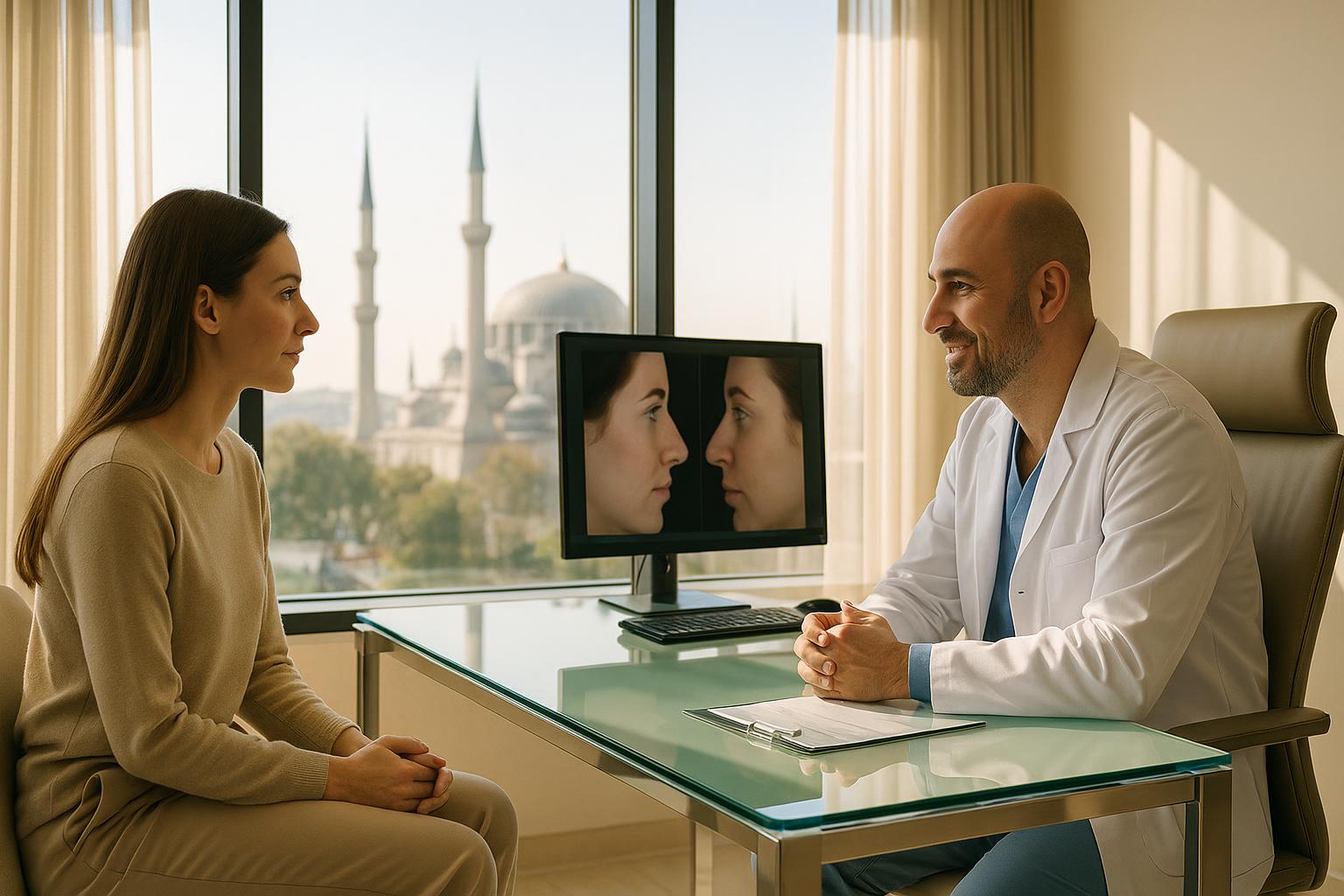
If you have had consultations locally, you know the format: twenty minutes, a few photos, a vague “we’ll make it smaller/straighter.” The turkey rhinoplasty consultation experience operates on a different wavelength entirely.
First, the time allocation. Ninety minutes is standard. Second, the technology. Most Istanbul clinics use advanced 3D simulation — not as a marketing gimmick, but as a collaborative planning tool. You rotate your own face on screen. The surgeon marks: “Here, we preserve this cartilage. Here, we add a spreader graft for breathing. Here, we refine the tip with sutures, not excision.” You see the plan, not just a promise.
Patients describe this as the moment anxiety shifts to excitement. The uncertainty — “will I look like a different person?” — dissolves when you can visualise a result that still looks like you, just refined. The best surgeons even show the limits: “This is what we cannot change because of your skin thickness,” or “This degree of rotation would compromise your airway.” That transparency builds the trust that carries you through recovery.
What Patients Wish They Had Asked
- How many revision rhinoplasties do you perform annually? (High revision volume signals peer trust)
- Do you use preservation / structural techniques, and why for my anatomy?
- What does my specific breathing assessment show?
- Can I speak with a past patient who had similar nasal structure?
- What does the first 48 hours of supported recovery look like hour by hour?
Key Takeaway: The consultation is a planning session, not a sales pitch. You leave with a surgical roadmap you understand — not just a quote.
Rhinoplasty Travel Logistics Istanbul: The Invisible Support System
Here is what no brochure tells you: the rhinoplasty travel logistics istanbul infrastructure is the silent hero of every patient journey. You book a flight. Everything else — airport transfer with a driver who knows exactly which clinic entrance to use, accommodation in a recovery-focused hotel or apartment two minutes from your surgeon’s door, a care coordinator who messages you at 6 AM on surgery day asking how you slept — materialises without you lifting a finger.
Patients from the UK, EU, and USA describe the same sensation: the mental load of “managing a medical trip abroad” evaporates. Your passport is photocopied for clinic registration before you’ve even unpacked. Your post-op medications are waiting on the nightstand. Lymphatic drainage massage — essential for reducing swelling — is scheduled before you ask. A nurse visits your room at 11 PM to check your comfort, adjust your head elevation, bring water.
This isn’t luxury for luxury’s sake. Rhinoplasty recovery demands stillness, elevation, cold compresses, medication timing, and emotional reassurance. When logistics are handled, you direct 100% of your energy to healing. Many patients note: “I could never have recovered this well at home alone.”
Key Takeaway: The logistics ecosystem exists to protect your recovery — not to upsell you. You arrive, you heal, you leave.
TL;DR — The Patient Journey in 5 Beats
- Research & Consultation: Video calls with high-volume nasal specialists, 3D planning, honest “no” to unrealistic requests
- Decision: Trust built on expertise transparency, not price pressure
- Arrival & Surgery: Seamless transfer, boutique recovery accommodation, surgery in internationally accredited hospital
- Supported Recovery (Days 1–7): Daily nurse visits, lymphatic massage, medications managed, splint removal around day 7
- Return & Refinement: Fly home cleared by surgeon; final result unfolds over 12–18 months with remote follow-ups
The Rhinoplasty Recovery Timeline Turkey Patients Actually Experience
Let’s talk about the rhinoplasty recovery timeline turkey patients live through — not the textbook version, but the human one.
Days 1–3: You sleep elevated, iced, medicated. Breathing through your mouth feels strange. The splint across your nose feels like a tiny helmet. You are tired — anaesthesia, travel, the emotional weight of finally doing this. Nurses check you every few hours. You watch Turkish dramas with subtitles. You nap. You are cared for.
Days 4–6: Swelling peaks around the eyes — “raccoon eyes” patients joke. It looks dramatic. It feels manageable. Lymphatic massage sessions (usually daily) make a visible difference each time. You venture to the balcony. You eat fresh simit and drink pomegranate juice. The internal splints or stitches feel weird but not painful.
Day 7 — Splint Removal Day: This is the emotional peak. The surgeon gently lifts the external splint. Tape comes off. You see your new profile for the first time — still swollen, still healing, but there. Patients cry. They laugh. They take photos they know are “too early” but cannot resist. The surgeon says: “This is 30% of the final result. Be patient.” You fly home the next day.
Weeks 2–6: The “social recovery” phase. You look presentable in photos with good lighting. Residual tip stiffness and morning swelling persist. You sleep on your back (still). You video-call your surgeon at week 3 and week 6. They reassure you: “This shadow will resolve. This stiffness is normal.”
Months 3–18: The slow magic. The tip softens. The dorsum settles. The skin shrink-wraps to the new framework. You forget you had surgery — until a friend says, “You look so rested, did you change your hair?”
Key Takeaway: Recovery is not linear. The supported first week in Istanbul handles the hardest part; the rest unfolds at home with remote surgeon access.
Rhinoplasty Before After Turkey Patients: The Subtle Art of “Still Me”
Scrolling rhinoplasty before after turkey patients galleries, you notice a pattern. The results don’t shout. They whisper. A softened dorsal hump. A tip that projects with intention rather than width. Nostrils that frame the face instead of dominating it. A profile that flows from forehead to chin without a sharp angle.
This is the signature of the Istanbul aesthetic: preservation over reduction, structure over excision, harmony over trend. Surgeons here have deep experience with Middle Eastern, Mediterranean, Caucasian, Central Asian, and African nasal anatomies — often in the same operating week. They understand that a “European” technique on thicker skin creates pollybeak deformities. That aggressive tip suturing on weak cartilage collapses in six months. That ethnic identity lives in the nose, and refinement must honour it.
Patients describe the result not as “a new nose” but as “my nose, finally finished.” The breathing improvement — often the surprise bonus — seals the satisfaction. “I didn’t realise how much air I wasn’t getting” is a refrain you hear again and again.
Key Takeaway: The best results are the ones only you and your surgeon know happened — natural, functional, enduring.
Rhinoplasty Worth It Patient Perspective: The Verdict Months Later
Ask a patient six months post-op: rhinoplasty worth it patient perspective — and the answer transcends aesthetics.
They talk about the photo they no longer dodge. The profile they no longer contour with makeup. The deep breath through both nostrils during a run. The confidence that shifted something in how they carry themselves into rooms. The trip to Istanbul that became a pivotal memory — not a medical errand, but a chapter of self-care in a city that feels like a reward.
They also talk about the things nobody warns you about: the weird nerve tingles at month 4. The morning swelling that lasts longer than Google said. The moment you catch your reflection in a shop window and genuinely smile. The gratitude for the surgeon who replied to your 11 PM WhatsApp photo at month 3 with “Perfectly normal, here is why.”
Would they do it again? “In a heartbeat.” Would they recommend it? “Only to people ready to be patient with the process.”
Key Takeaway: Worth it isn’t about the nose — it’s about the alignment between how you look and how you feel. That alignment changes everything.
Your Journey Starts With a Conversation
Every rhinoplasty turkey patient journeys story begins the same way: a message sent, a photo uploaded, a question asked. “Is this possible for me?” The answer comes not from a chatbot, but from a patient coordinator who has guided hundreds through this exact path.
You don’t need to decide today. You need information — real, specific, applicable to your face, your breathing, your timeline. That is what a free consultation provides. No obligation. No pressure. Just a specialist surgeon’s eyes on your photos, a preliminary plan, and answers to the questions keeping you up at night.
The patients you’ve read about in this article? They were where you are right now. Researching. Hesitating. Wondering if Istanbul is real or just marketing. They took the first step. The rest followed naturally.
Your turn.
Book Your Free ConsultationFrequently Asked Questions
How long should I plan to stay in Istanbul for rhinoplasty recovery?
Most patients stay 7 to 10 days, allowing time for the initial healing phase, splint removal, and a follow-up appointment before flying home comfortably.
What makes choosing a rhinoplasty surgeon in Istanbul different from local options?
Istanbul surgeons often perform a high volume of nasal procedures annually, with specific expertise in diverse ethnic nasal structures and advanced preservation techniques.
Is the rhinoplasty recovery timeline in Turkey different from other countries?
The biological healing process is the same, but the supported recovery environment — dedicated nurses, lymphatic massage, and clinic proximity — often makes the experience smoother.
What should I expect during a rhinoplasty consultation in Turkey?
Expect a thorough facial analysis, 3D imaging simulation, discussion of breathing function alongside aesthetics, and a clear surgical plan — all without pressure to commit immediately.
How do I manage rhinoplasty travel logistics for Istanbul?
Clinic Wise coordinates airport transfers, accommodation near your clinic, prescription medications, and daily check-ins — you simply arrive and focus on healing.

Rhinoplasty, commonly known as a nose job, is a cosmetic surgical procedure that involves reshaping or resizing the nose. Among Read more

A Comprehensive Guide to Achieving Your Ideal Nose Understanding Rhinoplasty: Transforming Your Nose, Transforming Your Confidence Rhinoplasty, also known as Read more

Have you considered having a rhinoplasty in Turkey? If you're considering having a rhinoplasty at Clinic Wise, learn about the procedures that Read more
Add a Comment