


Choosing between round vs teardrop breast implants comes down to your anatomy and vision. Teardrop implants mimic a natural slope; round implants offer fullness and symmetry. Both deliver beautiful, natural results when matched to your frame by an experienced surgeon.
Round vs Teardrop Breast Implants: Myths vs Reality for Natural Results
If you have been researching round vs teardrop breast implants, you have likely encountered strong opinions on both sides. Some forums insist teardrop is the only route to a natural look. Others swear round implants are the secret to youthful fullness. The truth sits somewhere in the middle — and it is far more nuanced than most blogs suggest.
At Clinic Wise, we guide patients from the UK, EU, and USA through this decision every week. The conversation rarely starts with shape. It starts with you: your tissue quality, your chest wall, your lifestyle, and the silhouette you see when you close your eyes. Shape is simply the tool that brings that vision to life.
Myth 1: Teardrop Implants Are the Only Way to Look Natural
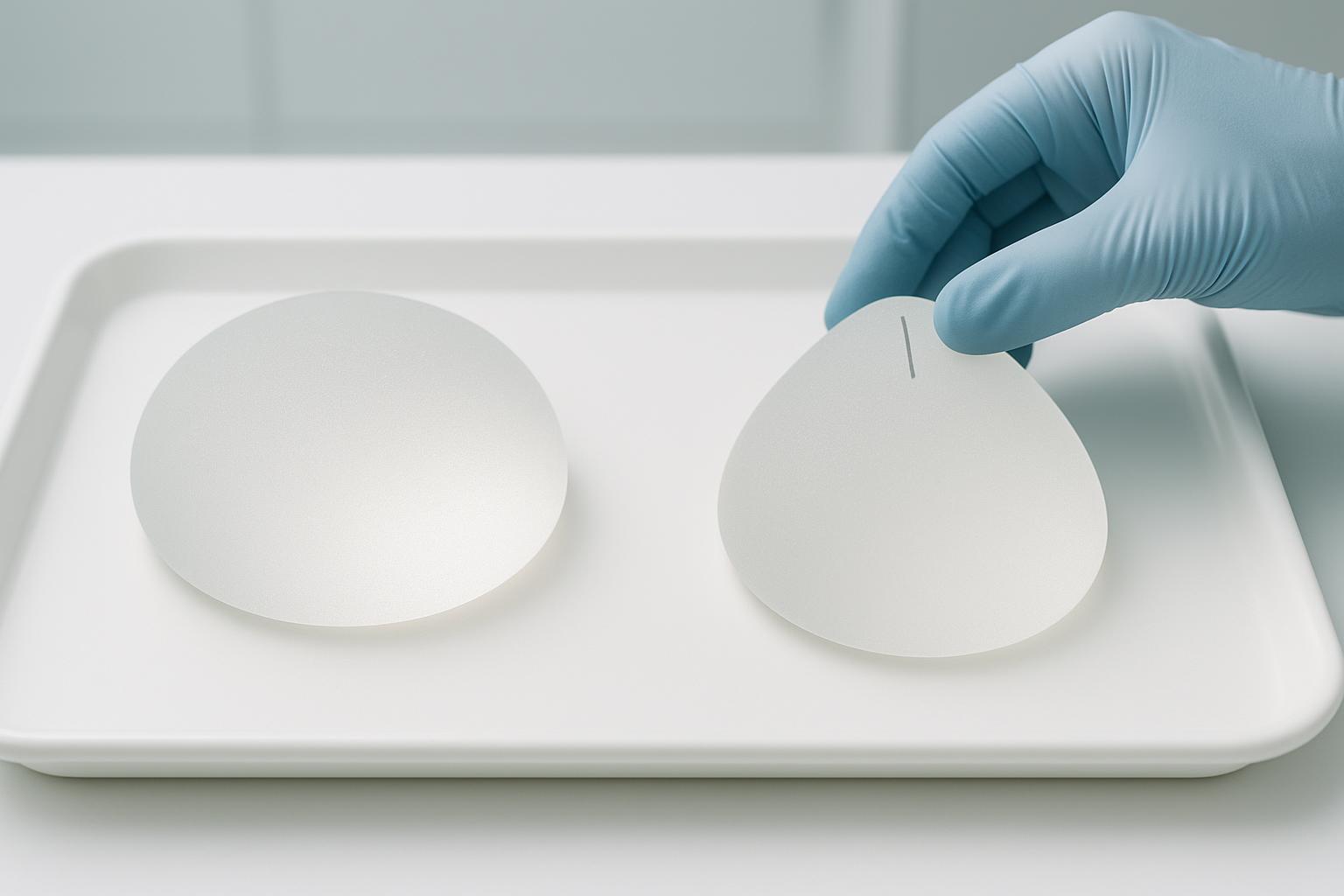
This is the most persistent myth in breast augmentation. The logic seems sound: anatomical implants mirror the breast’s natural taper, so they must look more “real.” But nature does not follow a single template.
Many patients have enough native breast tissue to disguise the upper-pole fullness of a round implant. When placed in a submuscular or dual-plane pocket, a moderate-profile round implant settles into a gentle slope that mimics the natural fall of breast tissue. The result reads as entirely organic — not “done.”
Conversely, a teardrop implant in a patient with very little native tissue can sometimes create a visible upper-pole edge if the pocket is not tailored precisely. The shape alone does not guarantee naturalness; the relationship between implant, tissue, and surgical plane does.
What matters more than shape category is implant shape comparison in the context of your specific anatomy. A skilled surgeon evaluates your breast base width, skin elasticity, and existing volume distribution before recommending either option.
Key Takeaway: Natural results come from matching implant characteristics to your anatomy — not from shape category alone. Round implants can look just as natural as teardrop when selected and placed thoughtfully.
Myth 2: Round Implants Always Look “Fake” or Overdone

This myth persists because early-generation round implants had high profiles and firmer gels that created a distinct upper-pole shelf — the telltale “bolted-on” look. Modern cohesive silicone gels have changed everything.
Today’s round implants span a spectrum of projections. A moderate or moderate-plus profile round implant behaves very differently from a high-profile one. The gel responds to gravity and movement, settling into a teardrop-like silhouette when you stand upright. Many patients are surprised to learn their “natural-looking” results came from a round device.
The breast implant projection guide matters more than the shape label. Projection determines how far the implant extends from the chest wall at its apex. A low-projection round implant creates subtle width; a high-projection round implant creates dramatic forward projection. Neither is inherently better — they serve different aesthetic goals.
Understanding Projection Profiles
- Low profile: Wider base, subtle projection. Suits broader chest walls seeking gentle enhancement.
- Moderate profile: Balanced width and projection. The most versatile option for natural results.
- High profile: Narrower base, significant forward projection. Ideal for narrower chests wanting noticeable volume.
- Ultra-high profile: Maximum projection for the most dramatic forward change.
Your surgeon maps these profiles to your breast base diameter — a measurement unique to you. This is why two patients receiving the same volume in cc can look completely different.
Key Takeaway: Modern round implants with moderate projection create beautiful, natural slopes. The “fake” look comes from mismatched projection or insufficient tissue coverage, not the round shape itself.
Myth 3: Teardrop Implants Never Rotate
Teardrop (anatomical) implants have a distinct orientation — fuller at the bottom, tapered at the top. They rely on textured surfaces and precise pocket creation to stay positioned. Rotation is rare with current devices, but it is not impossible.
If a teardrop implant rotates 90 degrees, the breast appears misshapen — fuller on one side, flatter on the other. A 180-degree rotation flips the slope upside down. Revision surgery corrects this, but prevention is the priority.
Experienced surgeons use several techniques to minimise rotation risk:
- Creating a precisely contoured pocket that mirrors the implant’s footprint
- Selecting implants with advanced surface technologies that promote tissue adherence
- Post-operative guidance on positioning and support garments during early healing
Round implants, by contrast, are rotation-agnostic. They look the same from every angle. For patients who value simplicity and peace of mind, this is a genuine advantage.
When Teardrop Shines
Teardrop implants excel for patients seeking:
- Reconstruction after mastectomy where no native tissue remains
- Correction of tuberous or constricted breast deformities
- A very specific anatomical slope with minimal upper-pole fullness
- Revision cases where previous round implants created undesired fullness
In these scenarios, the shaped implant provides control that a round device cannot.
Key Takeaway: Teardrop implants offer precise shape control for specific anatomies. Rotation risk is low with modern devices and expert technique, but round implants eliminate the concern entirely.
Myth 4: You Must Choose One Shape for Both Breasts
Asymmetry is the rule, not the exception. Most women have natural differences in breast volume, shape, or position between sides. A skilled surgeon may recommend different implant shapes, volumes, or profiles for each breast to create harmony.
For example, a patient with one breast that sits lower and has more lower-pole fullness might receive a teardrop implant on that side and a moderate-profile round implant on the other. The goal is symmetry in the final result — not symmetry in the implant box.
This level of customisation is standard practice at Clinic Wise. Our surgeons approach each breast as its own architectural project while maintaining the overall aesthetic vision.
Key Takeaway: Breast asymmetry is normal. The best surgical plans often use different implant specifications per side to achieve a symmetrical, balanced outcome.
TL;DR
• Teardrop implants mimic natural slope but aren’t the only path to natural results
• Modern round implants with moderate projection settle into organic contours
• Projection profile matters more than shape label for final appearance
• Teardrop rotation is rare but possible; round implants are rotation-proof
• Asymmetry often calls for different implants per breast
• Your anatomy — not internet opinions — should drive the decision
What Breast Implants Feel the Most Real?
Patients consistently describe the most natural-feeling results when three factors align:
- Cohesive silicone gel: Today’s “gummy bear” gels maintain shape while yielding to touch, mimicking natural breast tissue density.
- Submuscular or dual-plane placement: Muscle coverage over the upper pole softens edges and eliminates the palpable implant rim.
- Adequate native tissue: The more of your own tissue covering the implant, the more natural the feel.
Both round and teardrop implants come in cohesive gel formulations. The feel difference between shapes is negligible compared to the impact of placement plane and tissue coverage. A round implant under the muscle feels more natural than a teardrop implant over the muscle in a thin patient.
If what breast implants feel the most real is your priority, discuss tissue-based placement strategies with your surgeon. The shape conversation comes second.
Key Takeaway: Implant feel is driven by gel cohesivity, placement plane, and your natural tissue — not shape. Both round and teardrop cohesive gels feel remarkably similar to natural breast tissue when positioned correctly.
Choosing Implant Profile: The Decision Framework
When patients ask what breast implants are the best, they are usually asking about profile. Here is the framework our surgeons use:
Step 1: Measure Your Foundation
Breast base width (the diameter of your breast footprint on the chest wall) is the primary constraint. An implant wider than your base creates lateral spill and an unnatural wide-set appearance. An implant narrower than your base leaves gaps at the medial and lateral edges.
Step 2: Define Your Projection Goal
Do you want the implant to sit “on” your chest (lower profile) or project “from” your chest (higher profile)? There is no wrong answer — only alignment with your vision.
Step 3: Assess Tissue Dynamics
Tight, elastic skin accommodates higher projection differently than lax tissue. Your surgeon evaluates pinch test measurements and skin quality to predict how the envelope will adapt.
Step 4: Simulate in 3D
At Clinic Wise, we use advanced 3D imaging during consultation. You see your own torso with simulated implants in different shapes, volumes, and profiles. You rotate the view. You compare side by side. The guesswork disappears.
Step 5: Trust the Dialogue
The final decision emerges from conversation. Your surgeon brings technical expertise; you bring the vision. Together, you land on the combination that feels inevitable.
Key Takeaway: Implant selection follows a logical framework: base width → projection goal → tissue dynamics → 3D simulation → shared decision. Shape is one variable in a multi-factor equation.
The Clinic Wise Approach: Where Expertise Meets Empathy
Choosing between round vs teardrop breast implants is not a test you need to study for. It is a conversation you deserve to have with someone who has guided thousands of patients through this exact moment.
Our surgeons in Istanbul combine European board certification with deep experience in aesthetic breast surgery. They do not push trends. They listen, measure, simulate, and recommend — always with your long-term satisfaction as the compass.
The journey begins with a free, no-obligation consultation. You share your goals. We share our expertise. Together, we map the path forward.
Explore our Breast Implants service page to understand the full scope of what we offer. Browse real patient transformations in our Before & After gallery. Read authentic experiences on our Patient Stories page. And when you are ready to understand the full journey — from first message to post-operative care — our Patient Journey Guide walks you through every step.
Your natural result is waiting. Let us help you find it.
Book Your Free ConsultationReady to move from research to reality? Your consultation is the first step toward the silhouette you have been imagining.
Frequently Asked Questions
Do teardrop implants look more natural than round implants?
Teardrop implants mimic the natural breast slope with more volume in the lower pole, which can create a subtle anatomical look. However, modern round implants with moderate projection often achieve equally natural results, especially when placed under the muscle. The best choice depends on your existing breast tissue, chest wall shape, and aesthetic goals.
Can teardrop implants rotate after surgery?
Teardrop implants have a defined orientation and textured surfaces designed to minimise rotation. While rotation is possible, it is uncommon with current-generation devices and precise surgical pocket creation. Your surgeon will discuss techniques to optimise stability during your consultation.
Which implant shape has less rippling risk?
Rippling risk relates more to implant fill, placement plane, and your natural tissue coverage than shape alone. Both round and teardrop cohesive gel implants offer low rippling rates when positioned appropriately — typically under the muscle for patients with thinner tissue.
How do I know which implant profile suits my frame?
Profile (low, moderate, high, ultra-high) determines how far the implant projects from the chest wall at a given volume. Your surgeon evaluates your chest width, breast base diameter, and tissue elasticity to recommend a profile that balances projection with a natural transition at the upper pole.
Is the recovery different for round vs teardrop implants?
Recovery timelines are similar for both shapes when surgical technique and placement are comparable. Most patients return to light activities within one to two weeks. Teardrop implants may require slightly more precise post-operative positioning guidance initially, but overall healing follows the same trajectory.

Clinic Wise takes a comprehensive look at the reasons why women have breast reduction surgery. Have a good read... Breast Read more

A Complete Guide to the Best Recovery and Results Discover our plastic surgeons’ recommendations for breast lift surgery aftercare to Read more

Breast Reduction: Too big to live! What is breast reduction surgery? Breast hypertrophy is bilateral growth of breast tissue disproportionate Read more
Add a Comment